
Electric motors use almost 50% of the electricity in Europe and are subject to the EU’s ecological design requirements. These requirements fulfill energy efficiency criteria and are mandatory for all manufacturers and suppliers that wish to sell their products in the EU.
By using more efficient motors, it would be possible to save around 135 TWh of electricity in Europe by 2020, which is the equivalent of Sweden’s entire annual electricity consumption. This means that we would eliminate more than 60 million tons of CO2 emissions.
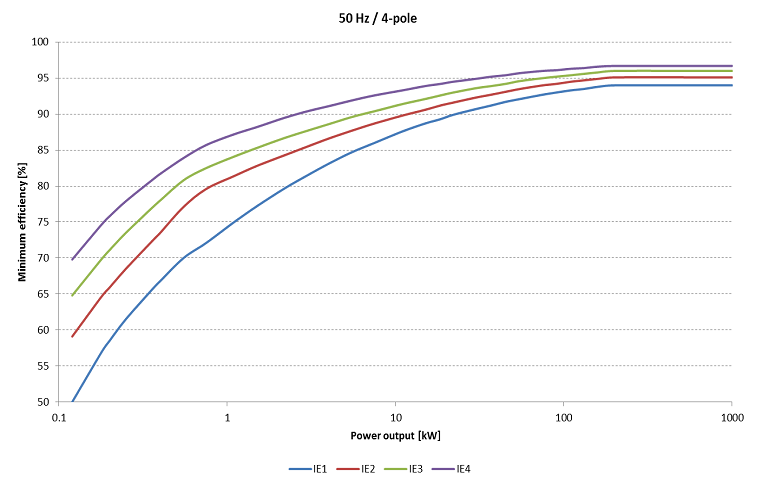
Regulation IEC 60034-30-1 (2014) currently defines four levels of energy efficiency for electric motors, covering a power range between 0.12 kW and 1000 kW.
There is also another Ecodesign Directive ErP or Directive 2009/125/EC that indicates in two separate points the need to provide information about the energy consumption of products, as well as their reuse for the purposes of sustainable development:
(12) In order maximise the environmental benefits from improved design, it may be necessary to inform consumers about the environmental characteristics and performance of energy-related products and to advise them on how to use the products in a manner which is environmentally friendly.
(14) ‘Reuse’ means any operation by which a product or its components, having reached the end of their first use, are used for the same purpose for which they were conceived, including the continued use of a product which is returned to a collection point, distributor, recycler or manufacturer, as well as reuse of a product following refurbishment.
At Motorlan, we have responded to the need to address these points in the following manner.
On the one hand, we draft a full efficiency report to determine the real performance of the motors that we receive for repair or reconditioning. You can download a summarized sample of these reports here. The full report includes a cost comparison and amortization in the event of replacing the motor with a more efficient model.
Logically, if the motor is burned out, the performance tests cannot be conducted until it is rewound and repaired.
Another factor to consider is that, after repairing and rewinding, the efficiency of the electric motor is generally affected by poor repair practices in workshops around the world.
In many countries, a significant part of the installed stock of electric motors fails every year, and most are repaired and put back in service. In China, for example, it is estimated that 10% of all electric motors installed in industrial applications fail during operation every year. 87% are repaired and placed back into service.
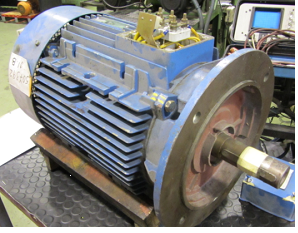
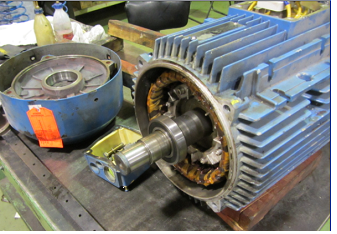
The motors are generally repaired 3 or 4 times before being replaced. The potential energy savings resulting from improved motor repair practices in the economy are enormous.
In the early part of the 2000s, there was the common belief that rewinding or repair of an AC induction motor systematically generated as much as a 2% loss of its original energy efficiency, depending on the classification of the motor. However, there are different non-traditional repair procedures that prevent reducing the level of energy efficiency as compared to new motors.
At Motorlan, we use these procedures to prevent the degradation of the motor’s efficiency during repairs. This requires us to:
- Meticulously record the winding data during dismantling, in order to exactly reproduce the original winding.
- Conduct tests on hot spots before and after rewinding, to identify stator losses.
- Prevent damage to the laminated plate during dismantling,
- During the rewinding process, ensure that there are no mechanical modifications or changes in the length of the conductors, the number of spirals or the cross-sectional area, according to the design by the original manufacturer.
- Always make mechanical repairs according to the manufacturer’s specifications, when available: checking for shaft wear, gaps, cracks, distortion, etc., as well as any aspect of the repair related to the bearings.
This ensures that we always provide motor owners all the information they need to decide on the best maintenance option for their motors. This may be continuing with the repair and reconditioning or to replace it with a new, more efficient motor.