
We often note that a repaired/remanufactured motor shows better performance than its original state when leaving the factory. This is largely due to the insulation recovery process.
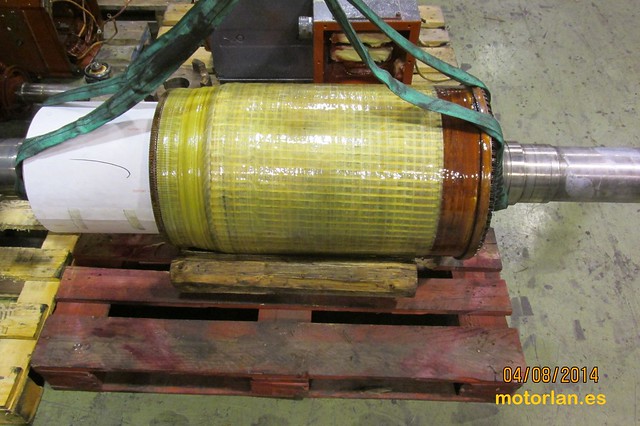
A practical example: after a good cleaning, we can use an impregnating varnish made from modified epoxy resins. Drying occurs by polymerization and very compact coils, with hardness, high adhesion and elasticity, are obtained. It offers very good resistance to refrigerant gases and aggressive oils. We can thus obtain THERMAL CLASS H (180ºC) insulations, which are often superior to those applied by the original manufacturer.
This is a common practice in MOTORLAN‘S repair procedures .
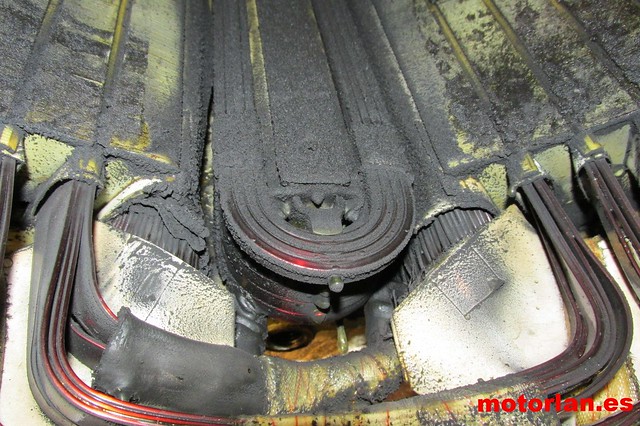
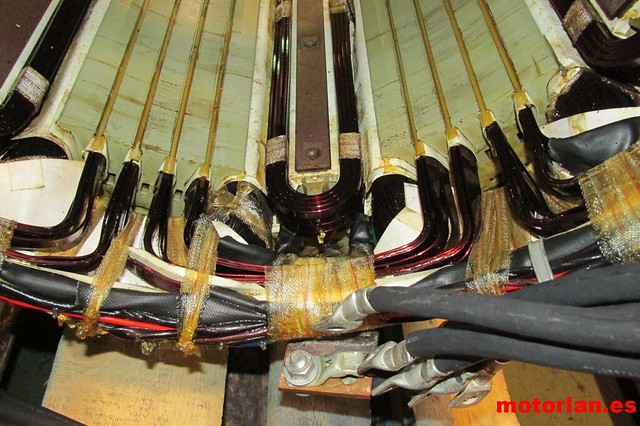
We then apply an ANTI-FLASH varnish, often red in color, with mineral fillers that confer special thermal conductivity and dielectric strength properties. We thus achieve high temperature resistance. However, its main feature is to protect the winding against sparks that may occur between the collector and the coil or between the collector and the metal casing of the motor. It is an anti-arc product. Its viscosity also allows the user to fill and close the gaps between the wires of the winding.
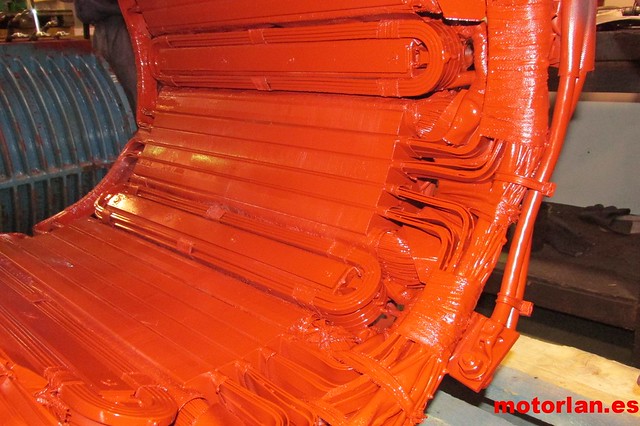
This is suitable for windings that must be subjected to moisture (underwater motors) or dusty environments. It is known that a large number of insulation short circuits and derivations in electric motors are due to the presence of bodies that have penetrated inside the turns of the coils. A winding protected ANTI-FLASH presents an even surface, over which water and dust have little chance to act. An engine that is treated with ANTI-FLASH has increased safety and presentation.