
Although it may seem perhaps an absurd question for connoisseurs, we often encounter this issue between maintenance technicians, who may come from more mechanical training or other specialties.
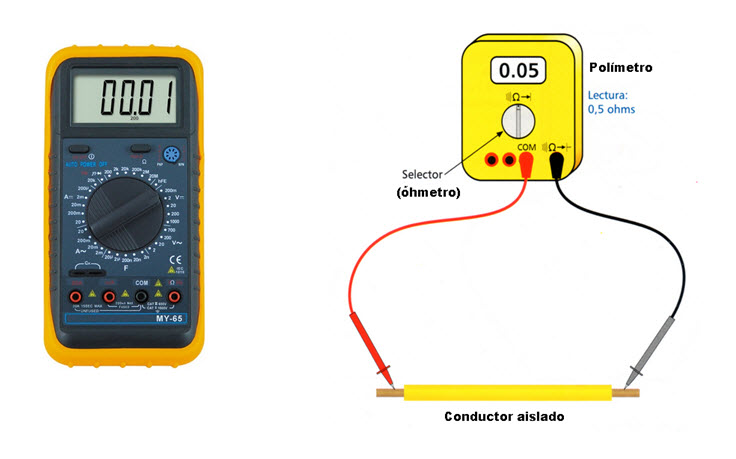 A multimeter is able measure different magnitudes, including electrical resistance, whose unit is given in ohms. Its operation, particularly to measure resistance, is given by the action of an internal battery (low voltage) that circulates a small current through the resistance being measured or, failing that, the conductor or winding. The value in ohm obtained belongs to the electrical resistance, which causes the current to pass through the conductor and is incremented according to its longitude and section.
On the other hand, a megohmeter, also known as Megger, is often used to measure the insulation resistance of an insulated body. For its operation, it uses a DC generator or a battery, which, alongside the electronic circuits, are able generate output voltage values of up to 5000V (depending on the model of the instrument). The results obtained in the ohm test are related to the insulation resistance, which has an insulated element relating to an active element or a conductor.
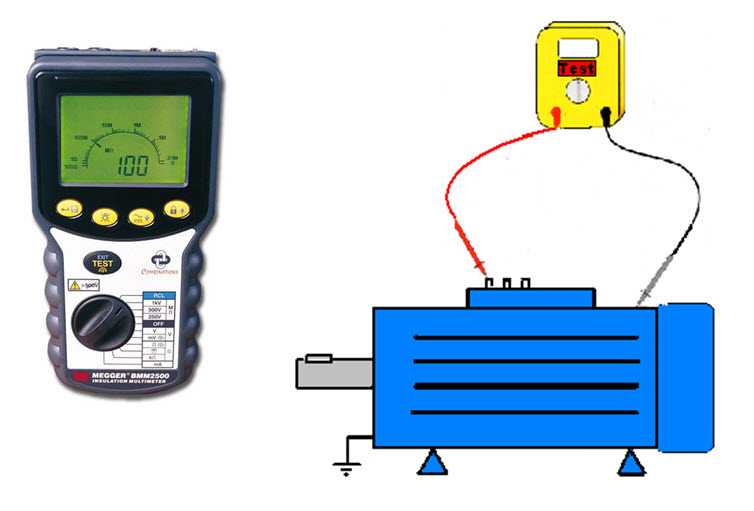 Although there is a degree of similar between both tools, the insulation resistance is mandatorily measured using a Megger (or a similar device), able to generate a high voltage that creates a moment of stress in the insulation (something that a multimeter is unable to do). Given that no insulation is perfect and unbreakable, a small current should circulate through it and, during the measurement, the ohmic value of the insulation resistance is calculated (based on the simple Ohm’s law: R= V / I), usually in Mega- or Tera-ohms, inclusive.
In conclusion, a multimeter measures the electrical resistance of a conductor (coil), while a Megger measures the insulation resistance of an isolated group (two coils relative to mass), something that a multimeter is unable to do.
…Why it is said that the Megger test is “destructive”.
Actually, it does not have to be.
An insulation has a much greater dielectric withstand voltages than the nominal operating voltages of a motor. In the test using the Megger, the motor is subjected to a voltage of 1000V (often depending on the motor) during a short time interval that, in other words, pushes to the limit the dielectric characteristics of the insulation, without damaging it.
If the insulation is in good condition, it should be able to easily bear the
voltage applied in the test. If, on the other hand, the insulation is deteriorated or broken, the voltage applied will break the insulation and may render it unusable or destroyed.
… Why the Baker test is considered “non-destructive”.
The Baker test allows the detection and evaluation of winding faults in electric motors. Its operation is based on generating a pulsed voltage (very brief pulses), introduced in the motor windings. Between the pulses, the winding coils react as an inductance (at pulse frequency), providing a slightly deformed sinusoidal signal. Each coil reacts uniquely, so the signal obtained will also be unique. By comparing both signals, the tester checks if the coils are identical and verifies if there is derivation between them (either between turns of different phases or turns of the same phase in the motor).
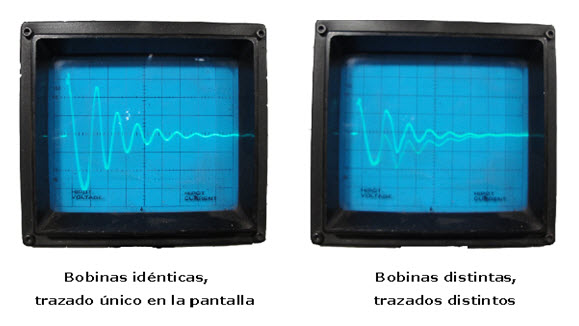 Because the applied voltage pulsates, the winding insulations are perfectly able to bear it.
… Dielectric withstand test: Megger or glow plug?
To check whether the insulation of an isolated element is correct, that is, its dielectric strength is high enough to insulate the conductive material, a dielectric strength measurement instrument or glow plug heater is enough.
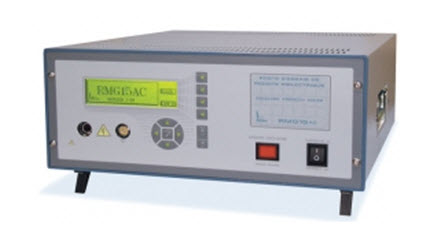 Its operation is based on the introduction of an adjustable voltage (1000V onwards usually) to all elements that are insulated from each other (e.g. stator laminations and windings), to check its behavior at a higher voltage than nominal operation. If the insulation is in good condition, that is, its dielectric strength is high, the test will be satisfactory. Otherwise, if there is a defect in the insulation, “sparks” will be caused by contact between the conductors or between a conductor and the plate (creating a short circuit).
When performing a test using the Megger, in addition to checking the condition of the insulation and verifying if its dielectric strength is sufficient, the test should also determine the ohmic value of the insulation resistance during the current flow.
+ info about the measurement of the insulation in BT electric motors (download here)